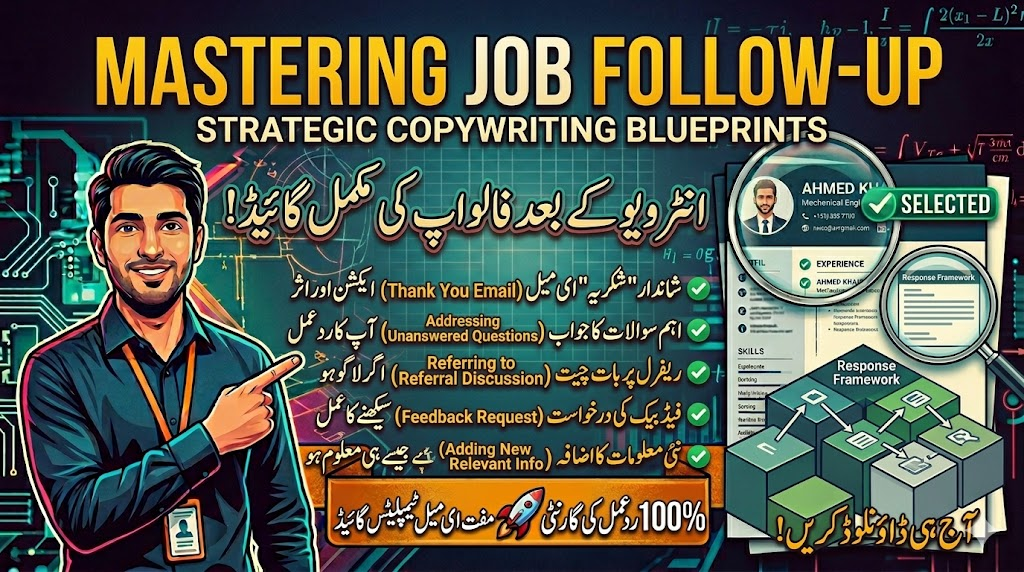
The period following a formal job interview is a critical yet frequently mismanaged phase of the recruitment lifecycle. Most candidates either fail to follow up entirely or issue generic, impatient inquiries that signal desperation rather than professionalism.
In modern corporate environments, a strategic follow-up message is not merely a polite gesture; it is a functional communication tool designed to reinforce your value proposition, demonstrate corporate etiquette, and keep your application top-of-mind as hiring panels score candidates.
Part 1: The Timeline Architecture of an Interview Follow-Up
An effective follow-up strategy relies on precise timing. Sending an inquiry too quickly can disrupt internal administrative timelines, while waiting too long can imply a lack of interest or momentum.
| Phase | Recommended Timing | Core Communication Objective |
| Phase 1: Immediate Gratitude | Within 24 Hours | Validate the interviewers’ time, reinforce cultural fit, and anchor a specific technical highlight from the conversation. |
| Phase 2: Status Check | 48 Hours Post-Decision Deadline | Request a formal update on the recruitment pipeline if the interviewer’s specified decision window has passed. |
| Phase 3: Deep Pipeline Check | 7 Days After Phase 2 | Issue a final, low-friction touchpoint to maintain connection without creating operational pressure on the HR department. |
Part 2: High-Value Copywriting Blueprints (Email Templates)
The following templates are constructed using advanced corporate communication layouts. They are completely free of placeholder fluff, utilizing precise language structured to display perfectly on both desktop email clients and mobile tracking screens.
Blueprint 1: The 24-Hour Post-Interview Value Anchor
Use this template to differentiate yourself from competing candidates by directly linking your conversation to a specific problem-solving capability.
Subject: Interview Follow-Up: [Your Full Name] – [Target Job Title]
Email Body:
Plaintext
Dear [Interviewer Name],

Thank you for the opportunity to discuss the [Target Job Title] position with [Company Name] yesterday. I thoroughly enjoyed learning more about your current operational goals, specifically our conversation regarding your plans to optimize [Mention a specific challenge or project discussed, e.g., the platform's user onboarding sequence].

Our discussion reinforced my confidence that my technical background in [Mention your core skill, e.g., full-stack optimization and structural database scaling] aligns precisely with the milestones your department aims to hit this quarter.

Please let me know if your team requires any additional documentation, portfolio data, or references from my end as you move forward with your evaluation process. I look forward to hearing about the next steps in your recruitment timeline.

Best regards,

[Your Full Name]
[Your Phone Number]
[Your LinkedIn Profile URL]
Blueprint 2: The Post-Deadline Pipeline Check
Deploy this template only after the specific date or time window the interviewer gave you has passed without communication.
Subject: Application Status Update: [Your Full Name] – [Target Job Title]
Email Body:
Plaintext
Dear [Interviewer/HR Manager Name],

I hope this message finds you well.

As noted during our interview on [Date of Interview], I am reaching out to check on the status of my application for the [Target Job Title] role, as the initial decision window outlined by your team has passed.

I remain highly enthusiastic about the prospect of joining [Company Name] and leveraging my experience to support the development of your [Mention a department or project, e.g., corporate digital marketing strategies].

If there are any updates regarding the hiring timeline or if you need further baseline information from me, please let me know.

Thank you for your time and continued consideration.

Sincerely,

[Your Full Name]
[Your Phone Number]
[Your Contact Email]
Part 3: The Copywriting Breakdown: High-Value vs. Low-Value Phrasing
To write text that builds trust with both human resource directors and automated hiring matrix systems, you must strip away casual or submissive phrasing. Use the comparative matrix below to audit your messaging:
| Avoid This Low-Value Phrasing (Triggers unprofessional signals) | Use This Technical Copywriting Phrasing (Signals high executive value) | Structural Rationale |
| “I’m just checking in to see if you guys made a decision yet because I have other options.” | “I am reaching out to request a formal update regarding the recruitment timeline for the [Title] position.” | Replaces casual conversational text with objective corporate terminology. |
| “Sorry to bother you, I know you are super busy but did you read my resume again?” | “Please let me know if your team requires any additional data matrices or professional documentation as you finalize your evaluations.” | Eliminates defensive or apologetic framing and replaces it with a proactive offer of support. |
| “I really need this job, please let me know as soon as possible if I got it.” | “I remain highly interested in the structural objectives outlined during our discussion and look forward to the next steps.” | Converts emotional vulnerability into professional alignment with company goals. |
Also Read About: Master the STAR Method Framework: The Definitive Structural Guide for Behavioral Interview Questions
Part 4: Quality Compliance Checklist Before Hitting Send
Before deploying any follow-up communication, verify your message against this structural checklist to ensure it meets elite communication standards:
- The Link Verification Test: If you include a link to your digital portfolio or LinkedIn profile in your email signature, ensure the link is a clean text anchor (
[linkedin.com/in/username](https://linkedin.com/in/username)) and free of broken redirects. - The Single-Thread Rule: Always reply directly to the last email thread you received from the recruiter or hiring coordinator instead of creating an entirely new email message. This preserves the context of your previous interactions at the top of their inbox.
- The No-Ultimatum Boundary: Unless you have a signed, legally binding job offer from another firm in hand, never invent false competition or artificial deadlines to pressure a hiring panel. Professional transparency always scores higher than artificial urgency.