
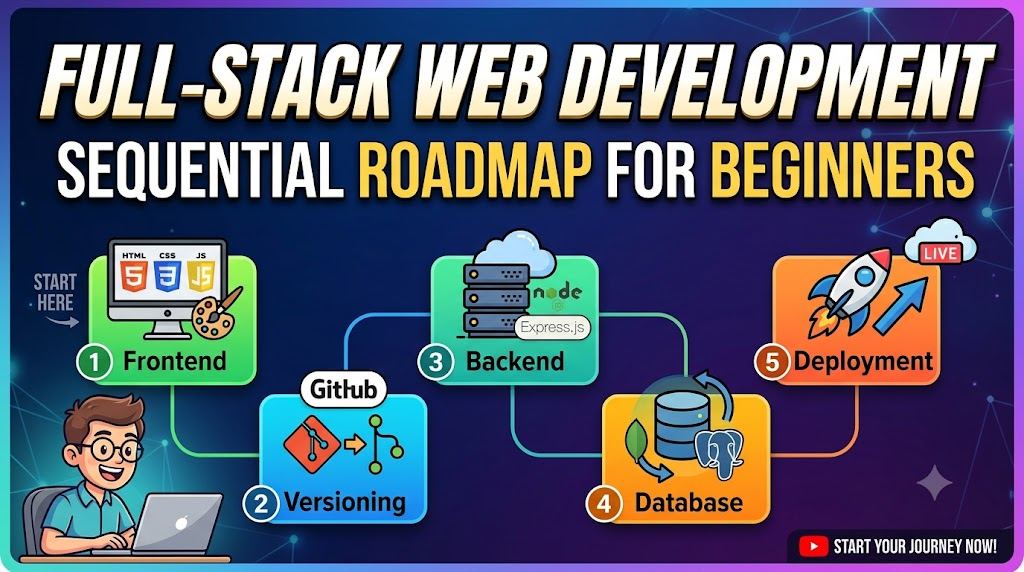
The domain of full-stack web development has evolved past simple text documents and basic styling scripts. Modern software applications require scalable system architectures, structured state management frameworks, computational data logic, and secure deployment pipelines.
The Sequential Architecture Roadmap
A full-stack engineering track must be executed in sequential layers. Skipping foundational stages to jump into advanced frameworks creates deep technical debt and structural code vulnerabilities.
Plaintext
[Layer 1: Frontend Foundations] ➔ [Layer 2: Advanced Frontend UI/UX] ➔ [Layer 3: Backend & Data Management] ➔ [Layer 4: DevOps & Cloud Architecture]
Layer 1: Frontend Foundations (The Document Object Structure)
Every application interacting with an end-user runs on three basic core computational execution layers inside the web browser client:
1. Structured Document Markup (HTML5)
- Core Logic: Learn to construct the document object hierarchy without relying on styling layout code.
- Technical Benchmarks: Master semantic document structures (
<header>,<main>,<article>,<section>,<footer>), form processing elements, structural validation rules, and accessibility compliance (ARIA mapping parameters).
2. Layout & Presentational Layer (CSS3)
- Core Logic: Separate document markup from visual layout. Avoid legacy absolute positioning patterns and move toward programmatic visual structures.
- Technical Benchmarks: Master the Box Model constraints, CSS Flexbox layout alignment, CSS Grid multidimensional structures, variable tracking, responsive fluid typography configurations, and media query breakpoint optimization.
3. Client-Side Compute (Modern JavaScript – Vanilla ES6+)
- Core Logic: Before introducing frameworks, you must master asynchronous data handling and programmatic DOM manipulation using native web browser APIs.
- Technical Benchmarks: Understand lexical variable scoping (
let,const), operational data arrays, arrow function syntax, object destructuring, promises, asynchronous execution flows (async/await), and programmatic document interaction using the native Fetch API.
Layer 2: Advanced Frontend Architecture & State Management
Once the document layout and client compute operations are stable, transition to component-based frontend framework systems to scale the user interface layer.
| Framework/Tool | Core Technical Scope | Practical Portfolio Impact |
| Component Library (React.js) | Virtual DOM diffing algorithms, modular component architecture, functional hooks (useState, useEffect). | Enables the build-out of high-performance user interfaces with isolated, reusable UI code blocks. |
| State Management Context | Component tree state data propagation, global data state vectors, atomic data stores. | Prevents component prop-drilling errors, ensuring scalable client data processing. |
| Styling Compilation (Tailwind CSS) | Utility-first CSS class tracking, atomic design configurations, automated unused style purging. | Drastically increases development efficiency while minimizing the production layout style packet size. |
Layer 3: Backend Infrastructure & Relational Data Control
Full-stack capability is achieved when you move the application logic off the browser client and into a dedicated, secure server environment capable of processing long-term database storage.
1. Server-Side Execution (Node.js & Express.js)
- Core Logic: Building an event-driven server runtime environment designed to handle continuous network requests and route parameters securely.
- Technical Benchmarks: Build out explicit REST API endpoints (
GET,POST,PUT,DELETE), implement strict request routing parameters, configure CORS handling, and build modular server-side middleware for data validation.
2. Database Design & Optimization (SQL vs NoSQL)
- Core Logic: Structuring persistent database engines to safely store, index, query, and retrieve structural user and application data payloads.
- Technical Benchmarks:
- Relational Model (PostgreSQL / MySQL): Master schema modeling, primary and foreign key constraints, table normalization, and transactional multi-table JOIN operations.
- Document Model (MongoDB): Understand dynamic document indexing, document embedding structures, aggregation pipelines, and JSON-like collection mutations.
3. Security, Authentication & Cryptography
- Core Logic: Protecting server-side API access routes and securing sensitive user data at rest and during transmission.
- Technical Benchmarks: Implement secure password hashing utilizing the bcrypt encryption protocol, configure stateless session tracking with JSON Web Tokens (JWT), and validate incoming user data models to protect against SQL Injection and Cross-Site Scripting (XSS) vectors.
Layer 4: DevOps, CI/CD Pipelines & Cloud Architecture
An application running locally on a developer’s machine has zero real-world utility. The final layer of the full-stack track focuses on cloud deployment and automated delivery pipelines.
1. Version Management Engineering (Git & GitHub)
- Core Logic: Managing incremental source code iterations and coordinating distributed collaborative engineering workflows.
- Technical Benchmarks: Master advanced branch isolation protocols, semantic commit tracking, pull request code review processes, conflict resolution engineering, and strategic repository structures.
Also Read About: 10 Best Freelancing Skills for College Students in Pakistan (2026 Guide)
2. Container Configuration Architecture (Docker)
- Core Logic: Standardizing application runtime boundaries to eliminate environmental deployment bugs between local configurations and remote servers.
- Technical Benchmarks: Write explicit, multi-stage
Dockerfiles, optimize base operational layers, and writedocker-compose.ymlconfigurations to orchestrate your application server and database simultaneously.
3. Production Hosting & Continuous Integration (CI/CD)
- Core Logic: Configuring public cloud computing platforms to automatically pull, test, containerize, and serve production-ready application updates.
- Technical Benchmarks: Configure automated deployment tracking hooks (GitHub Actions), map custom DNS route parameters, configure automated SSL certification management, and monitor performance analytics on cloud computing clusters (AWS, Render, or DigitalOcean droplet instances).
Verification Protocol for Architectural Readiness
Before applying for technical engineering positions or publishing a full-stack portfolio project, audit your application architecture against this system compliance checklist:
- The Decoupling Verification: Is your frontend application completely separated from your backend server framework, interacting exclusively through programmatic API network data payloads? If your backend is rendering the actual markup directly within the server engine, refactor it into an isolated REST API setup.
- The Database Query Audit: Are your long-form database records indexed properly to minimize retrieval latency, and are your environment configuration variables (database credentials, private JWT string keys) completely scrubbed out of your public code repositories? Use an isolated
.envsystem configuration layer. - The Mobile Responsive Matrix: Does your layout canvas scaling scale gracefully across a 320px mobile viewfinder up to a 1920px wide-screen layout without structural line breaks or layout breaking?